
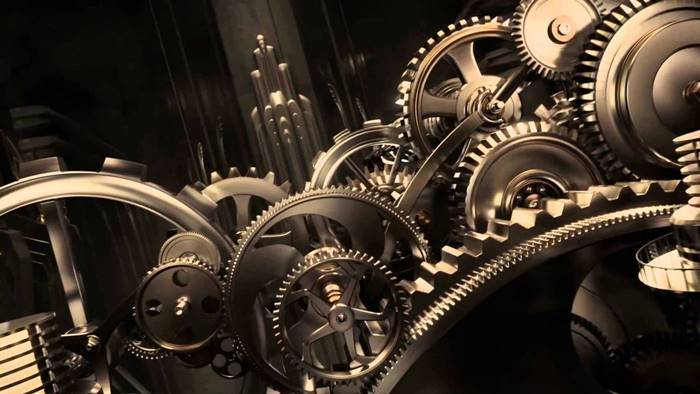
A machine is defined as a system composed of various mechanical components—such as gears, bearings, and shafts—designed to convert one form of energy into another, perform a task using a specific force, or produce an effect. Electronic or organic devices that lack any mechanical parts are also referred to as machines. Machines have been developed to assist human or animal power, or to completely replace it, in performing a specific task or fulfilling a physical function. They encompass a wide range of devices, from simple machines such as levers, inclined planes, and pulleys, to highly complex systems like a modern automobile. Machines can operate by converting thermal, chemical, nuclear, or electrical energy into mechanical energy—or vice versa—or they may simply serve to transmit or adapt forces and motion. All machines have input and output components, as well as components for adaptation, conversion, and transmission. Machines that obtain their input energy (input) from natural sources such as wind, flowing water, coal, oil, or uranium and convert this energy into mechanical energy are called primary movers (primary engines). Windmills, water wheels, turbines, steam engines, and internal combustion engines are primary motors. The output energy (output) generated by these machines can typically be fed as input to other machines—such as electric generators, hydraulic pumps, or compressors—via rotating shafts. These last three devices fall into the category of generators; the electrical, hydraulic, and pneumatic energy they produce can be used as input for electric, hydraulic, or pneumatic motors. These motors are used to operate machines that produce various types of outputs, such as material processing machines like machine tools, packaging and conveying machines, or sewing machines and washing machines. Machines that do not fall into the primary drive, generator, or motor class are called processors (operator machines); the processor category includes all manually operated devices, such as calculators and typewriters. In some cases, machines from all categories are combined into a single unit. For example, in a diesel-electric locomotive, the primary drive is the diesel engine; this engine powers the generator, which in turn drives the motors that turn the wheels.